
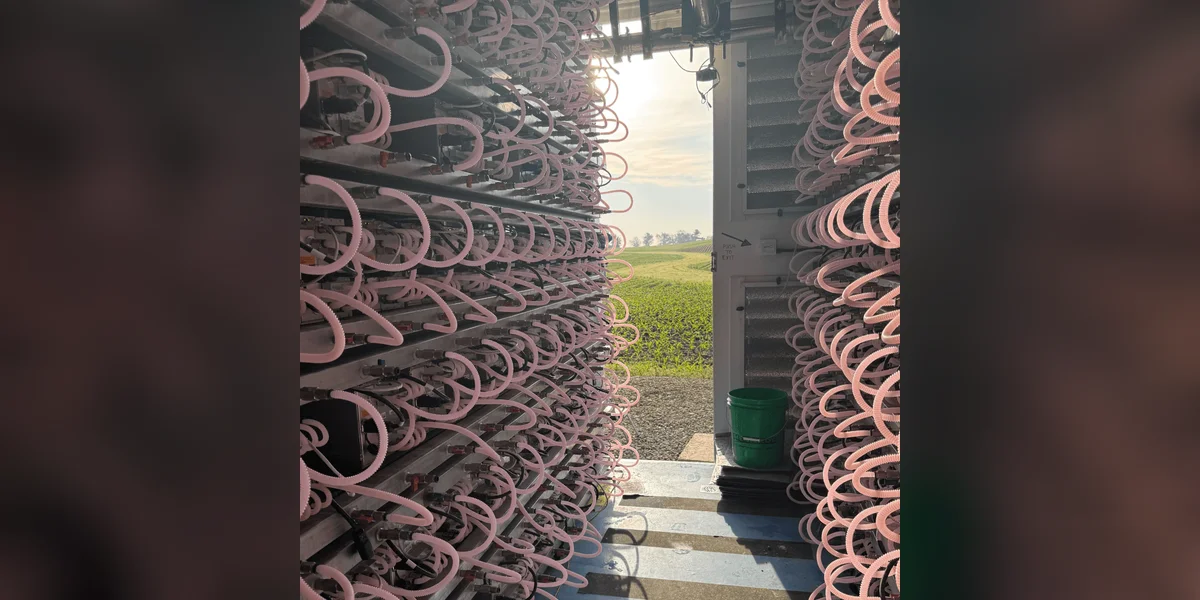
Hydro-cooled sites succeed or fail on the quality of their electrical integration. Pump control, miner plugs, sensors, relays, and safety chains must all work together from day one.
The legacy cabinet notes become a field workflow you can use during wiring, verification, and commissioning.
Download File
Download the Hydro Electrical Wiring Manual
Combined PDF with Cabinet A, Cabinet B, and Control Cabinet C wiring drawings from the original field manuals.
Key Takeaways
- De-energize, meter, and label everything before making changes.
- Treat pump-control logic, sensor inputs, and emergency-stop loops as commissioning-critical systems.
- Keep cabinet labeling accurate enough that the next technician can validate every termination without guesswork.
Deployment
Safety Rules Before Any Wiring Work
- Disconnect the main power supply and verify zero voltage with a meter before touching any component.
- Use insulated tools, gloves, and eye protection, especially around wet or recently serviced equipment.
- Never bypass emergency-stop lines or lockout logic to speed up testing.
Non-negotiable standard
If cabinet labeling is unclear, stop and relabel before energizing. Hydro sites scale too quickly for undocumented wiring assumptions.
Deployment
Miner Plug Distribution and Grounding
Each miner plug should be fed through its own three-phase breaker, with L1, L2, L3, and protective earth landed directly to the corresponding plug terminals.
Large cabinets often contain more than one hundred plug positions grouped in numbered banks. Accurate #X-Y labeling is part of the electrical safety system and the service workflow.
- Terminate all ground conductors back to the cabinet grounding bar and verify bond integrity.
- Match phase rotation consistently across plug groups to prevent difficult-to-trace commissioning issues.
- Document breaker-to-plug mapping before miner installation begins.
Deployment
Pump, Sensor, and PLC Wiring
| Subsystem | Field rule | Why it matters |
|---|---|---|
| Circulating pump | Land motor phases through overload, contactor, and relay logic before startup testing | Prevents nuisance trips and confirms the PLC can command the motor cleanly |
| Spray pump | Mirror the circulating-pump control pattern and confirm status feedback returns to the PLC | Keeps pump control behavior predictable across cabinet variants |
| Flow sensor | Use shielded twisted-pair cable into the PLC analog input | Reduces noise in the most important cooling-health signal |
| RTD sensors | Terminate each sensor cleanly into the correct analog module slot | Temperature noise or mis-landing creates false alarms and bad operator decisions |
The original field notes called for 6 AWG conductors on higher-power motor circuits and lighter-gauge control conductors for signaling. Keep those separation rules intact when cabinet modifications are made later.
Deployment
Communications, IP Plan, and Emergency Stops
- Keep PLC, HMI, router, and RS485 devices on a documented address plan before the first technician laptop connects to the system.
- Verify that all emergency-stop buttons are wired in series through the proper terminals and that every coil in the stop chain drops correctly during testing.
- Test button functionality during commissioning instead of assuming the cabinet was shipped correctly.
Commissioning shortcut worth keeping
After wiring is complete, validate the E-stop chain before live miner installation. It is the fastest way to catch cabinet logic mistakes while the system is still easy to inspect.
Deployment
Commissioning Checklist
- Verify every plug termination, including protective earth, against the cabinet map.
- Run pump contactors and overload protection through a controlled test sequence.
- Confirm PLC input and output states for pumps, sensors, and status feedback points.
- Check live sensor values for temperature, pressure, and flow before miners are energized.
- Test emergency-stop behavior and phase-voltage readings one final time before go-live.